Risk Register — Fintech Edition (Free)
141 pre-populated fintech risks across 21 categories. ISO 31000 structure. Ready to use in a week.
About This Template
Building a risk register from scratch is painful. This one comes loaded with 141 risks across 21 categories — credit, compliance, cyber, vendor, model — all written for fintechs and financial services. Drop in your scores, assign owners, track trends, and present to your board in a format that makes sense. Comes with a 26-page guide covering scoring methodology, treatment strategies, and a 30/60/90 day implementation plan.
The risk taxonomy is ISO 31000 aligned but written in plain English — no consultant-speak, no 47-layer hierarchy. Each risk has a suggested inherent score, control description, and residual score so you can see what "good" looks like before you start customizing. Most teams have this live within a week.
Who Is This For?
- → You're building a risk register from scratch and don't want to start with a blank spreadsheet
- → You need a risk inventory that covers fintech-specific categories like model risk and BSA/AML
- → Your board or bank partner has asked for a risk register and you need something defensible quickly
- → You're inheriting a risk program and need to assess what risks are being tracked vs. what's missing
- → You want an ISO 31000-aligned structure without paying a consultant to build it
Preview
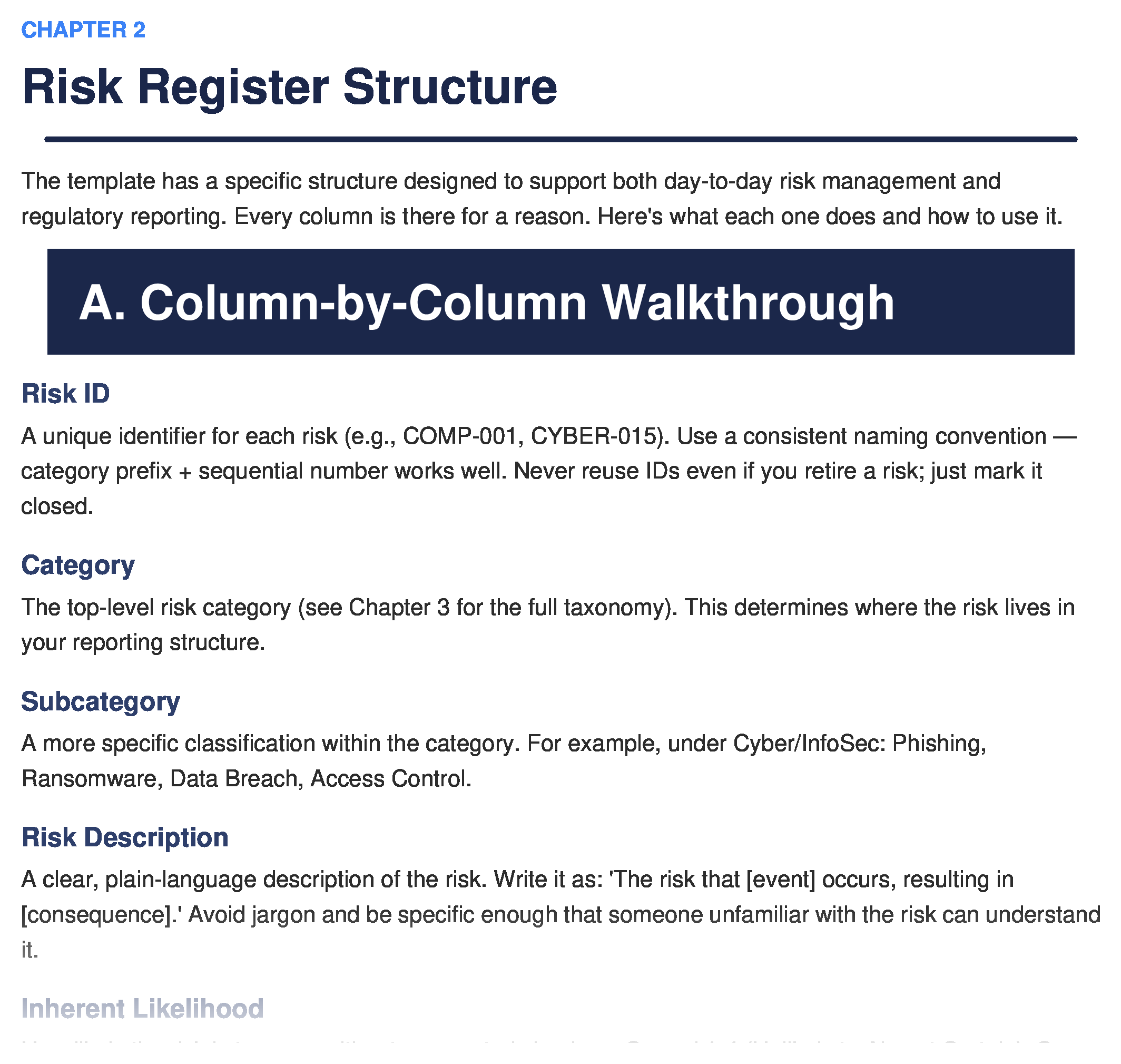
Risk register structure — 8 required fields per risk: category, description, inherent score, controls, residual score, owner, treatment, next review
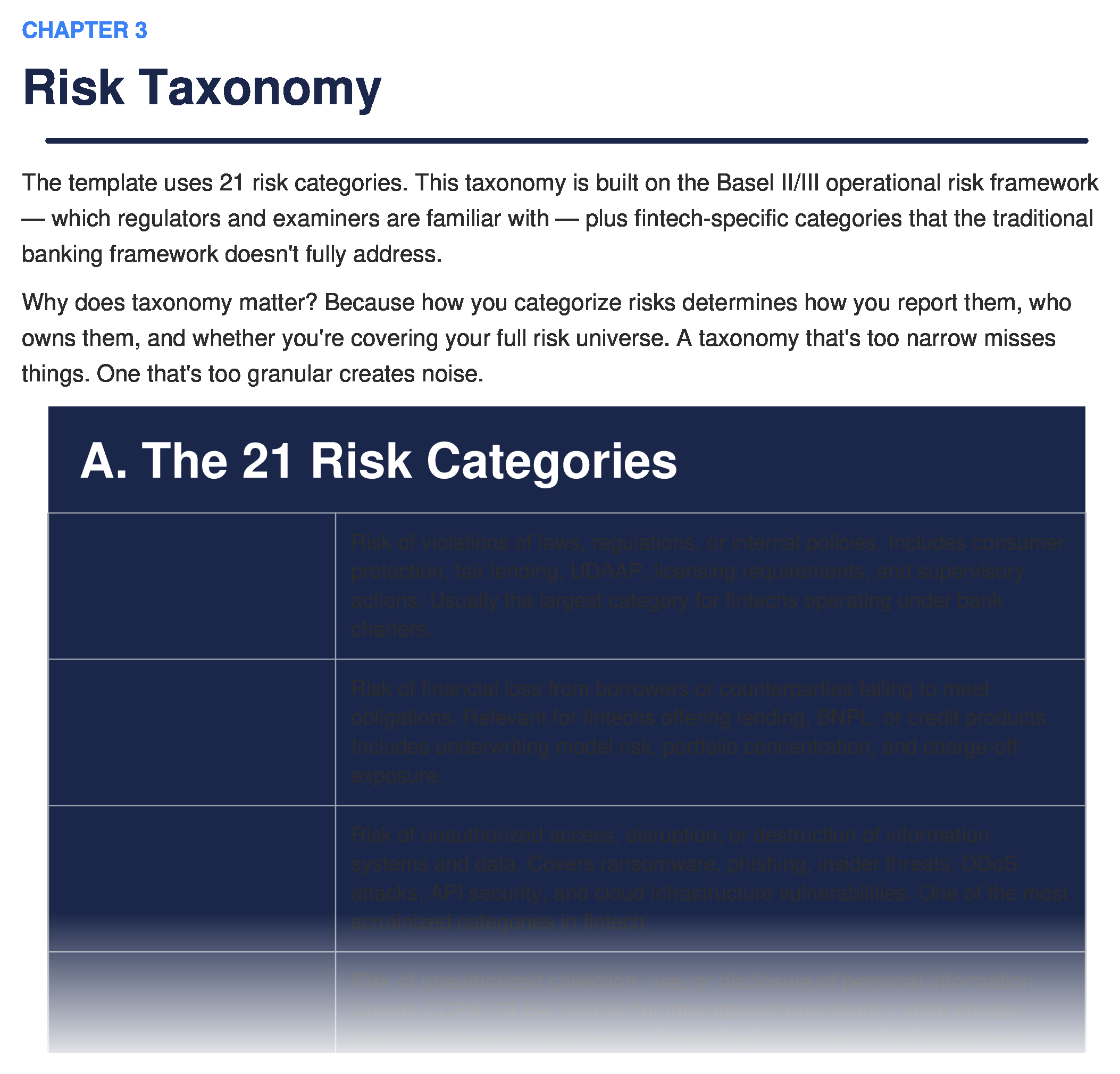
21 risk categories — from Operational and Credit Risk to Reputational, Compliance, and Strategic
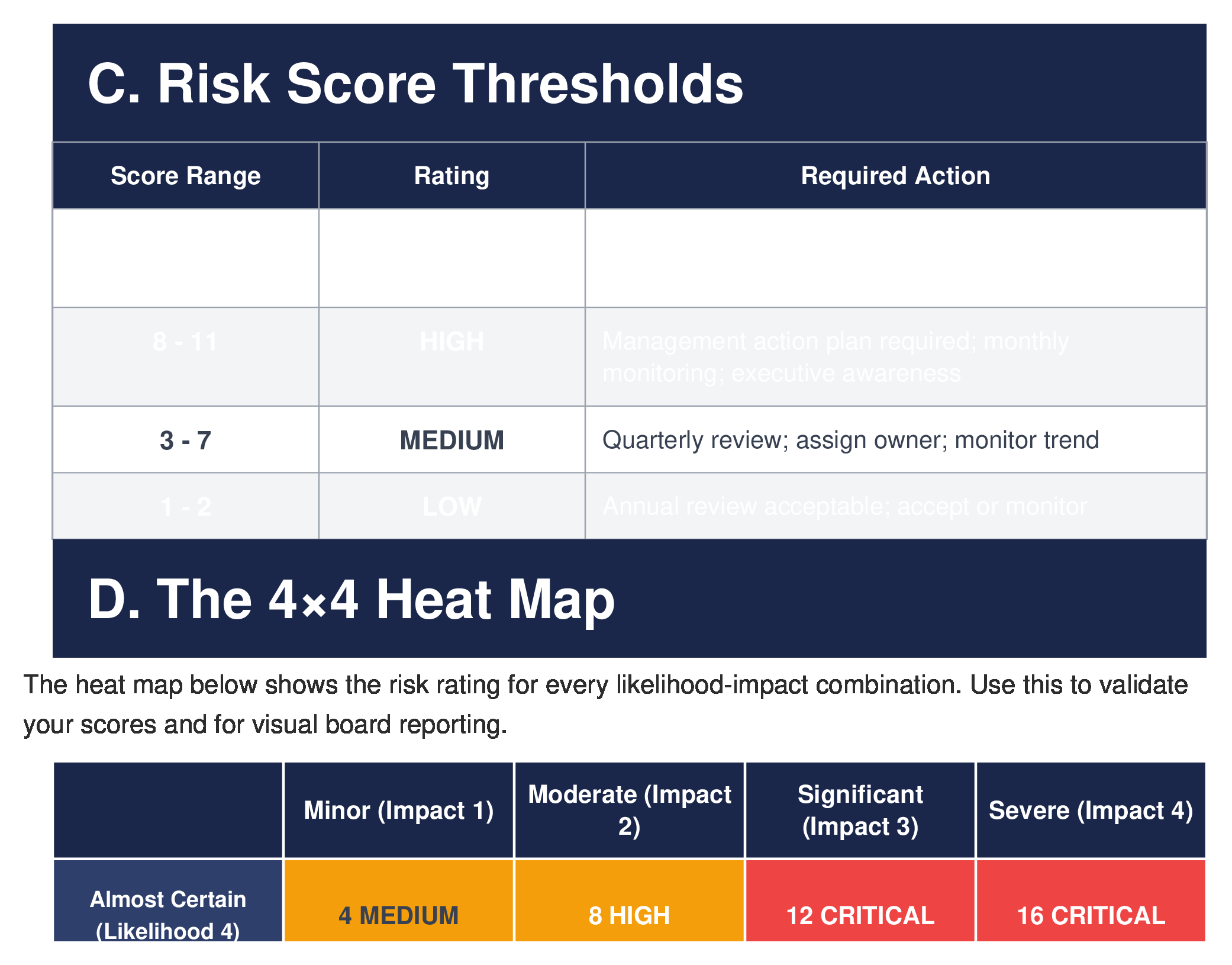
4×4 risk scoring thresholds — score ranges, ratings, and required actions from Low to Critical
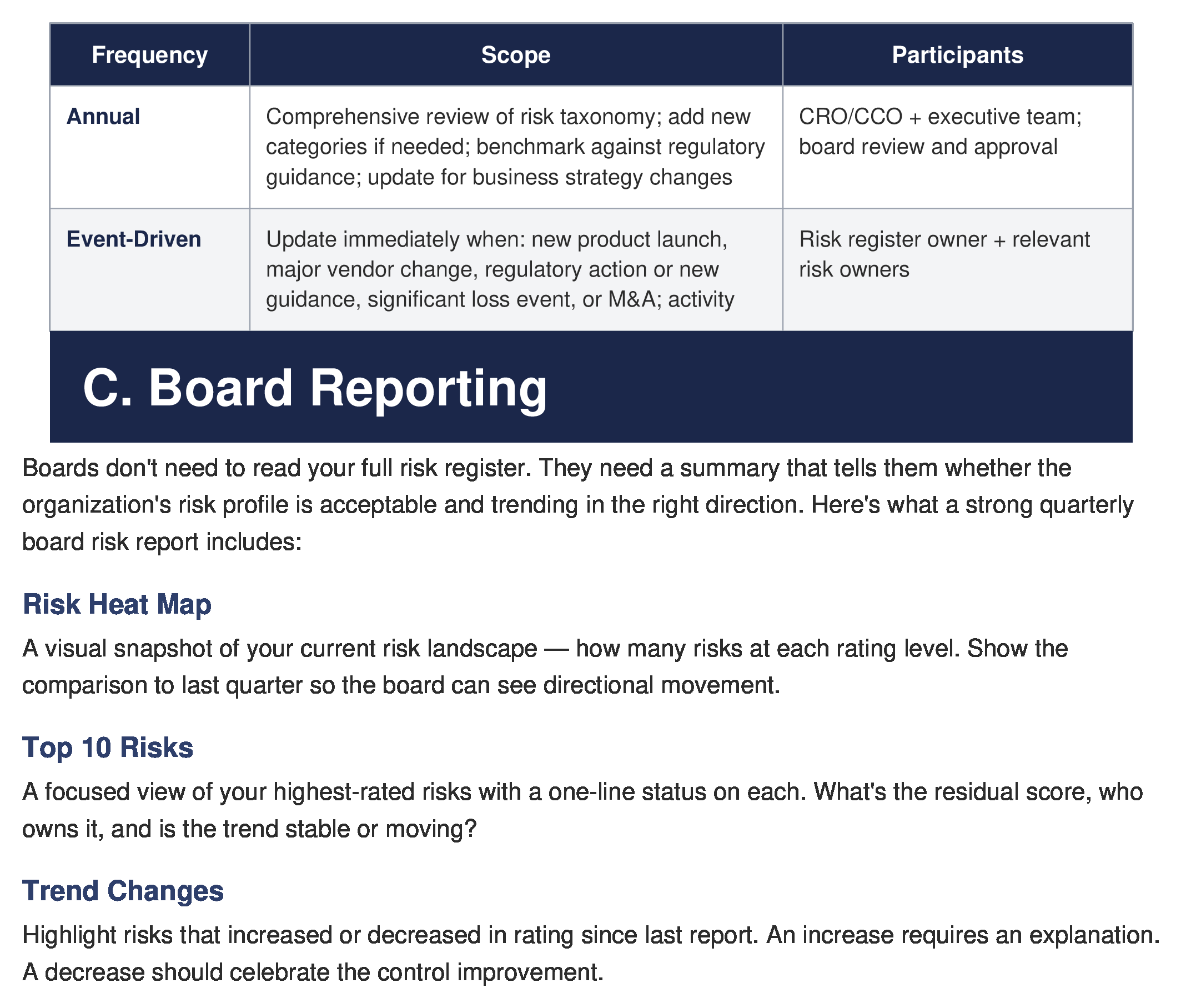
Governance & reporting cadence — annual, quarterly, monthly, and ad-hoc review frequencies by stakeholder
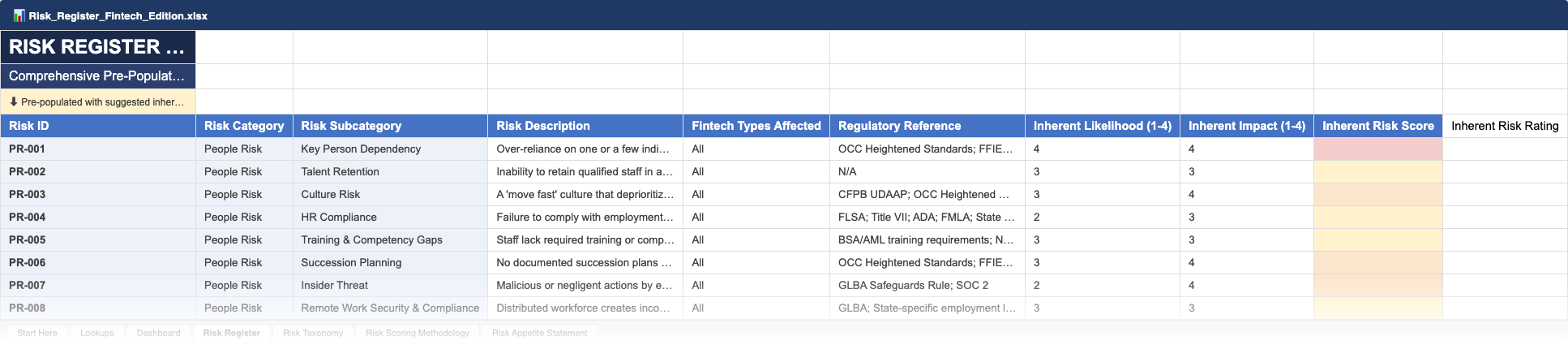
Excel template — Risk Register with 21 pre-populated risk categories, scoring, and control mapping
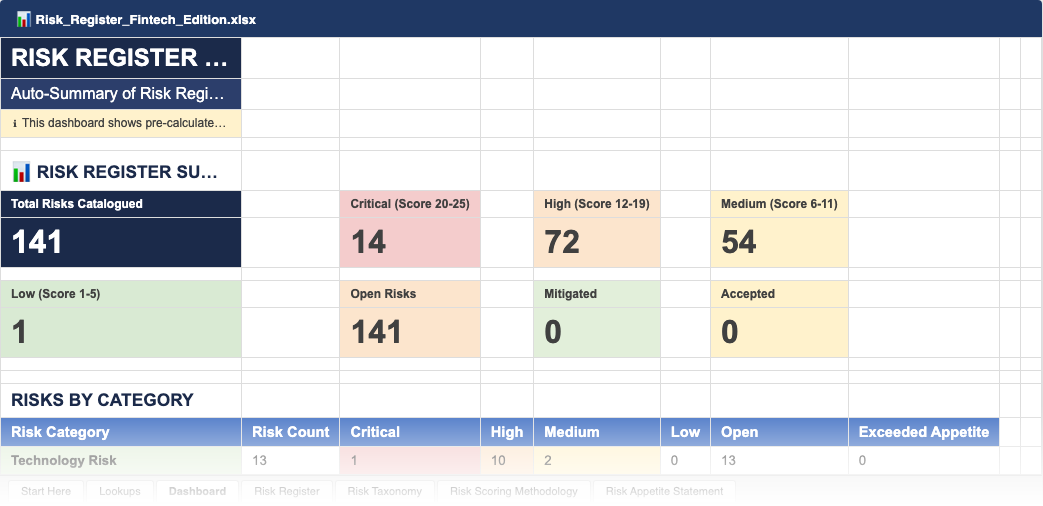
Risk Dashboard — risk distribution by category, heat map summary, and upcoming review dates
What's Included
- 141 pre-populated fintech risks
- 21 risk categories
- ISO 31000 aligned structure
- Scoring methodology guide
- 30/60/90 day implementation plan
Download Risk Register — Fintech Edition (Free)
Enter your details and we'll email you the download link.
We'll email you the download link. No spam, ever.
Frequently Asked Questions
How are the 141 risks organized across the 21 categories?
The 21 categories follow an ISO 31000-aligned taxonomy — covering Operational, Credit, Compliance, Cyber/InfoSec, Vendor, Model, Strategic, Reputational, BSA/AML, and 12 others. Each risk has a suggested inherent score, a control description, and a residual score so you can see a realistic baseline before customizing for your environment.
What does the 30/60/90 day implementation plan include?
The 26-page guide walks through: days 1–30 (populate scores, assign owners), days 31–60 (validate scores with business lines, identify top 10 risks), days 61–90 (present to board/risk committee, establish review cadence). Most teams have the register live and board-ready within a quarter.
What does "ISO 31000 aligned" mean in practice?
ISO 31000 is the international standard for risk management frameworks. Aligned means the structure, terminology, and methodology follow that standard — which matters when your bank partner or auditor asks what framework your risk register uses. It doesn't mean you need to be formally certified.
Can I use this register for a board risk report?
Yes. The Excel template includes a risk dashboard tab that shows risk distribution by category, a heat map summary, and upcoming review dates — designed to be pasted into a board deck without additional formatting. The scoring guide includes language for presenting to board and executive audiences.
What's the difference between this free register and the paid RCSA or ERMF?
The Risk Register identifies and scores your risks. The RCSA ($69) evaluates whether your controls are working against those risks. The ERMF ($79) provides the governance structure — risk appetite, 3 Lines of Defense, and committee charter — that the register and RCSA operate within. Think of them as foundation, evaluation, and governance.
Related Products
KRI Library (132 Key Risk Indicators)
132 KRIs with thresholds, data sources, and escalation triggers pre-built for financial services.
RCSA (Risk & Control Self-Assessment)
141 pre-populated fintech risks with control assessments, questionnaire framework, and testing calendar.
Enterprise Risk Management Framework (ERMF)
Complete ERM documentation: risk appetite, 3 Lines of Defense, committee charter, and board reporting.
Ready to Get Started?
Download this free resource and start building your risk program today.
Download Free →